
Free Ready-to-Progress maths assessments
Our Check assessments can be used with the whole class to identify areas of strength and where pupils may need further support. One-to-one Diagnose tasks then help you better understand what may be getting in the way of their progress.
Our RTP assessments
Choose a year group, a Ready-to-Progress strand, or both.
Assessments will be released over the coming weeks ready for September.
29 assessments
Number and Place Value
Number Facts
Addition and Subtraction
Multiplication and Division
Fractions
Geometry
No assessment for that combination yet. Try another year group or strand.
Check, then Diagnose, then teach.
The wider Groundwork Maths model has three stages, each with a specific job. These assessments give you the first two. The third is where the teaching happens.
Check
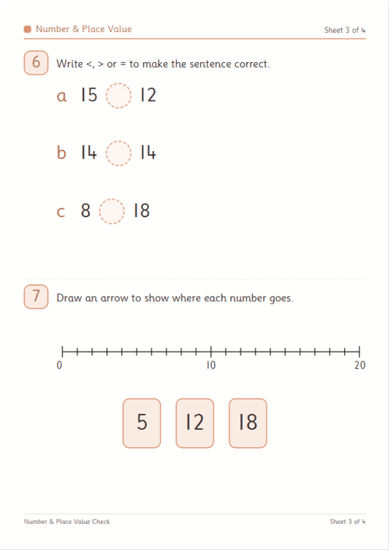
A short written assessment the whole class completes. It shows you where pupils may be struggling, and often gives you a first sense of why.
Diagnose
Short tasks, used only with the few pupils a Check has flagged. Here you confirm exactly what is going on, by talking a problem through with the pupil.
Teach
Once you know the gap, you can teach specifically to close it. Our Groundwork Maths programme is designed to help here, though you can close the gap in whatever way suits your class.
What makes our assessments different is how they are built. In the Check, a wrong answer points to a likely cause, not simply to the fact that a pupil got it wrong, and the questions are designed to identify pupils who reach a right answer using an inefficient method. The Diagnose tasks then help you confirm what is actually going on.
A whole-class check, low stakes by design.
A short written assessment you can give to the whole class, either before teaching to see how secure pupils' understanding is, or after teaching to see what has stuck. Each one takes between 15 and 30 minutes, depending on how many questions an RTP criterion needs.
You are not marking how many questions a pupil got right. You are looking through their answers for the mistakes that point to a real gap or misconception, so the Check shows you which pupils are worth a closer look and where to spend your time.
Small gaps left unattended early on often stay hidden, then surface later when pupils meet work that depends on them. Finding them now gives you time to close them.
- Check AssessmentQuestions for pupils to complete.
- Check Teacher GuideAnswers and notes to help you review the Check.
- Check Record SpreadsheetRecord results across the class.
Tasks for the pupils a Check flags.
For the few pupils a Check has flagged, we offer a set of short tasks that help you confirm the precise gap, so your teaching can go straight to what each pupil needs.
Each task is a short conversation that a teacher or TA works through with a pupil. You look at what they get and how they reach an answer, as this often tells you as much as the answer itself.
A pupil only does the tasks tied to the flags their Check raised, not the whole set.
- Diagnose Teacher GuideThe tasks and what to look for.
- Diagnose Task Supporting ResourcesResources needed for the tasks.
- Diagnose Record SheetRecord the gaps identified for each pupil.
How we decide what to check.
For each assessment we start from the relevant RTP criterion and break it down into a set of can-do statements. Each one is a specific thing a secure pupil should be able to do, and the assessment looks at each in turn.
Recognise repeated addition contexts, representing them with multiplication equations and calculating the product, within the 2, 5 and 10 multiplication tables.
Pupils must first be able to recognise equal groups. To better understand and identify equal groups, pupils should initially explore both equal and unequal groups. Pupils should then learn to describe equal groups with words.
| Our can-do statement | Drawn from |
|---|---|
| Identify equal and unequal groups, describing them as groups of, for example 3 groups of 5 | The teaching guidance, which names recognising and describing equal groups as the first step |
| Write a repeated addition expression for an equal-groups context | The teaching guidance on representing equal-group contexts with repeated addition |
| Write a multiplication expression for an equal-groups context | The teaching guidance on moving from repeated addition to multiplication expressions |
| Show that a repeated addition expression and a multiplication expression are equivalent, for example 5 + 5 + 5 = 3 × 5 | The teaching guidance on equivalence, and the DfE example questions that rewrite additions as multiplications |
The criteria are the DfE's. The can-do statements are our interpretation, our way of breaking each criterion into the specific things to check. We write them to stay true to what the criteria intend, but they are not the DfE's own wording.
A few things schools ask.
Do you need to use the Groundwork Maths programme afterwards?
No. Groundwork Maths is one way you could teach to the gaps a Check finds, but it is entirely optional. The Check assessments and Diagnose tasks are free, and will always be free to use.
We already do lots of assessments. Is this not just another one?
It is another assessment, and before using the Check or Diagnose it is worth thinking carefully about its purpose and how it sits alongside everything else you do. It might be additive, giving you information you do not already have, or it might replace something you currently use. Where you do use it, we would recommend treating the Check and Diagnose together as one approach rather than in isolation.
Do these assessments take a long time?
We have tried to design them to be as efficient as possible. On the Check, we do not recommend marking for right answers. Instead you are looking for the wrong answers and misconceptions that point to a gap. There is some time investment, but one of the main reasons pupils carry gaps into older year groups is that those gaps are not picked up early enough. Finding them early means there is still time to close them.
Do I have to use all of it, or can I just use the Check?
Just the Check is fine. Plenty of teachers use it on its own to see where a class is. Equally, you might go straight to the Diagnose tasks if your own assessments have already shown you the issues a pupil has. It is your call which parts you use and when.
Do I have to do the whole assessment, when one covers four criteria?
That is your choice. You can split an assessment into two or three parts if it helps. For example, you might give just the number line questions from the Number and Place Value assessment to check how secure pupils are on number lines.
When do you recommend using the assessments?
We see three main uses.
- Straight after teaching a concept in its year group, to check understanding while it is fresh.
- By the class teacher the following year, before moving on to the same concept, to see what gaps the class may have so you can reteach.
- To find gaps in older pupils' understanding. For example, a Year 6 pupil struggling with numbers to 1,000 could do the Number and Place Value Check from an earlier year group. Our Checks are not labelled by year group, so it does not draw attention to the year it comes from.
Do I need strong maths subject knowledge to make sense of the results?
No. The Check Teacher Guide tells you what to look for in each question and what each common mistake usually means, so you are not left to work it out alone.
The RTP criteria include some assessment questions. Have you used those?
Yes, we have drawn on the assessment questions in the DfE guidance as part of building these. The assessment is not simply those questions written out, though. To get properly at the issues underneath, we have used our own expertise to design it.
When will the assessments all be released?
We will be releasing the assessments over the next 4–6 weeks ready for use in September. We wanted to give you a flavour of them now for planning purposes.