
Our approach
What does a session look like?
Every session builds the pictures and the words pupils need to make sense of the maths, one micro-step at a time.
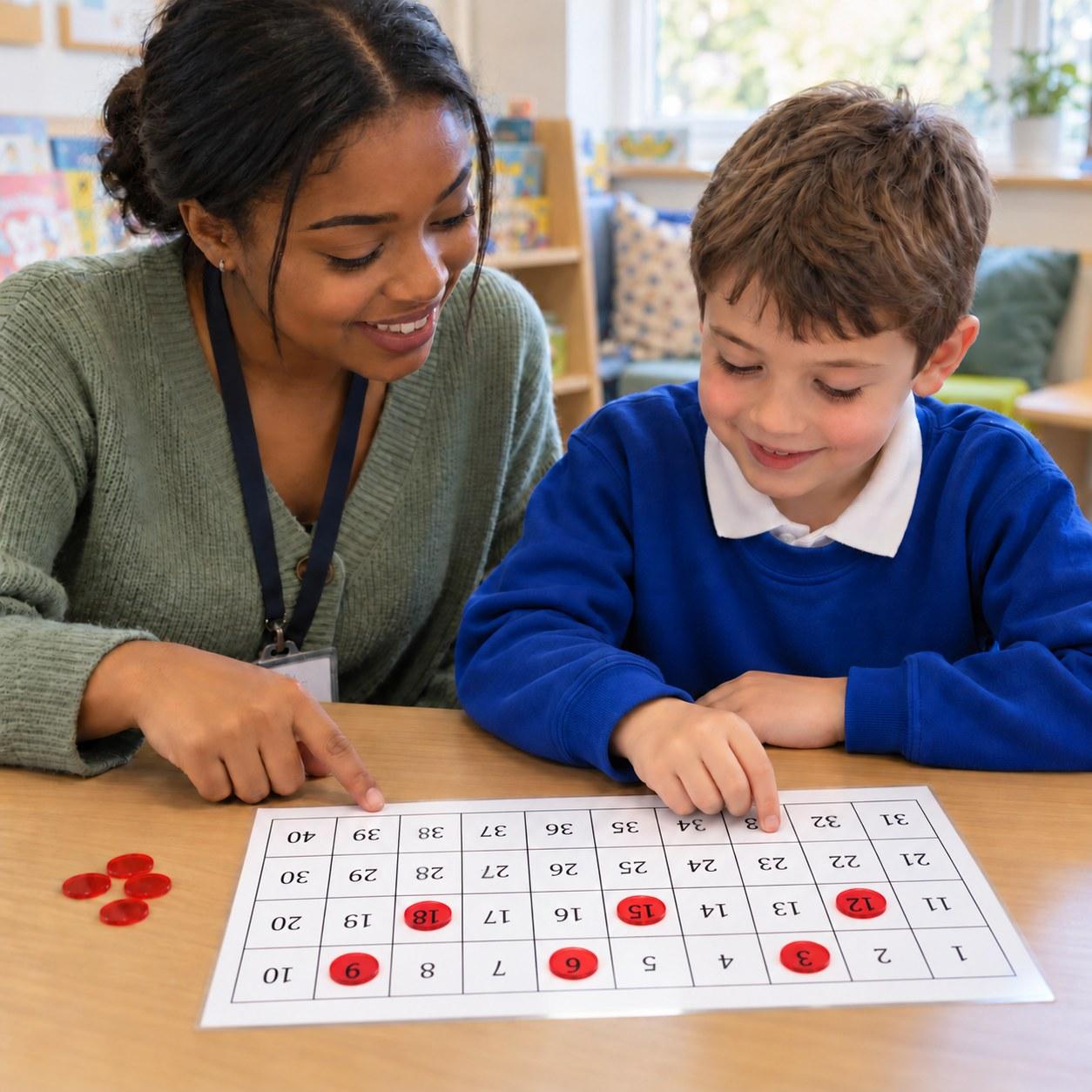
A picture you’ll recognise.
In a typical class there’s a wide range of prior understanding, with a big difference between the highest and lowest attainers. That makes teaching harder, and the pupils who find maths hardest are often the ones whose needs are hardest to meet inside the lesson.
So schools arrange extra support, in the lesson or outside it, usually led by a teaching assistant. It’s a real commitment of time and care, and you want it to make a difference.
We built Groundwork Maths to help with this.
It starts with two free assessments. The Check is a short written assessment for the whole class, which shows you which pupils need support. The Diagnose tasks are short one-to-one conversations with the pupils the Check flags, which help you find what’s really getting in the way. The Groundwork Maths sessions then teach the missing pieces, with training and support for the adults teaching them.
How we designed Groundwork Maths
These are the things we cared about most when we designed Groundwork Maths.
Built on research
Groundwork Maths is designed around teaching approaches recommended in guidance from the Education Endowment Foundation (EEF) and the Department for Education. These include clear modelling, micro-steps, equipment and pictures, talking about the maths and regular practice. The Evidence Behind Groundwork Maths explains each one.
Read about the evidenceHands-on and screen-free
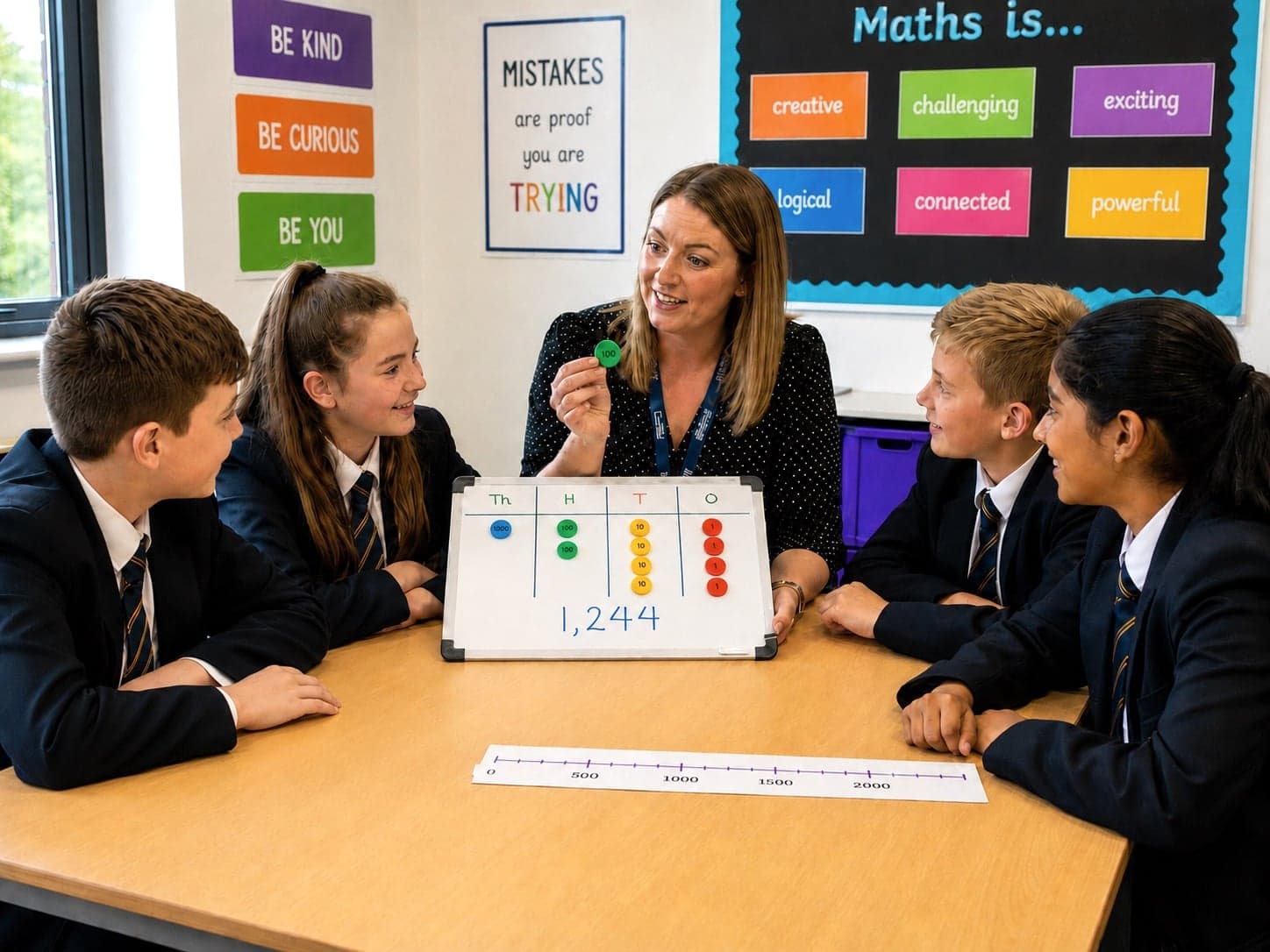
Pupils build numbers with counters, ten frames, and rods and cubes, place numbers on number lines and record what they’ve made. Almost every module is built around one key piece of equipment, so pupils get to know it well and can focus on the maths. There are no screens in sessions, so the focus stays on the equipment, the drawings and the talk.
Groundwork Maths builds the mental images pupils can draw on. Every session includes a moment where pupils picture the maths in their heads, without the equipment in front of them. As their understanding becomes secure, pupils rely less on the equipment and move towards written and mental methods. They can always go back to it when it helps.
Helping pupils feel successful
Pupils who need Groundwork Maths have often found maths hard for a long time. Each session is planned so they can succeed with a small, clear piece of learning. From one session to the next only a small part changes, so pupils aren’t asked to hold too many new ideas at once, and they can feel their own progress. We want them to leave every session feeling they can do maths.
Clear for the adult, with room for their own style
Each session card concisely shows what to teach, what to say and what to look out for. Adults keep to the order of steps on the card, but they use their own words, set the pace and bring their own personality to the session. They’re responsive to what pupils show them, while keeping to the session as it’s written.
Enjoyable to teach and to learn
We want sessions to be something the adult and the pupils look forward to. That’s why they’re short, hands-on and built around talking together.
Mathematics is a language, and pupils need to hear it and speak it to learn it. In every session pupils say the key mathematical sentence aloud and talk with a partner about what they see. The structure gives them the words, and the talk gives them the confidence to use them.
The four parts of every session
Sessions last 20 minutes and always follow the same four parts. It’s a calm, predictable routine, so the focus stays on the maths.
- 3 to 4 minutes
Activate
A quick reminder of what pupils need for today’s learning.
See an example
Pupils quickly recall that 8 needs 2 to make 10, the fact they will use in a moment.
- 5 to 6 minutes
Represent
The adult models the new idea, then pupils try an example of their own, often using equipment and pictures. It ends with pupils picturing the maths in their heads.
See an example
The adult models 8 + 5 with a ten frame of 8, moving 2 across from a second frame to make 10, then adding on the rest. Pupils then work through 8 + 7 using exactly the same method, looking at what is the same and what is different.
- 3 to 4 minutes
Say it
Pupils explain the idea out loud, using sentence starters.
See an example
“8 and 2 makes 10. 10 and 3 more is 13.” Said together, said to a partner, said by a few.
- 5 to 7 minutes
Practise and prove
Pupils practise and show what they can do.
See an example
Pupils solve a set of additions through 10 on their own, then answer “How do you know 9 + 4 is 13?”
Schools can also choose a longer 60-minute format for pupils with more to rebuild. The Groundwork Cycle page explains how the two formats work.
See the two formatsA session card for every session
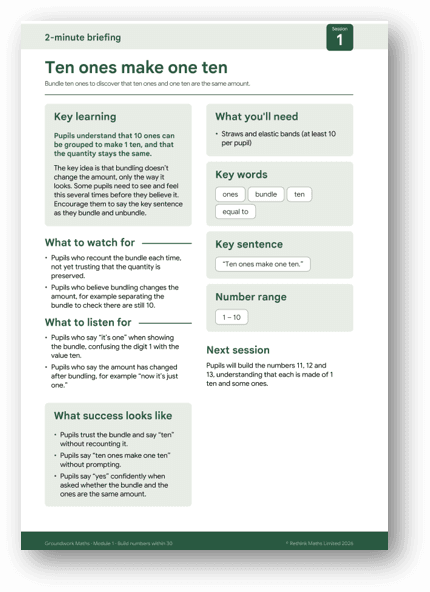
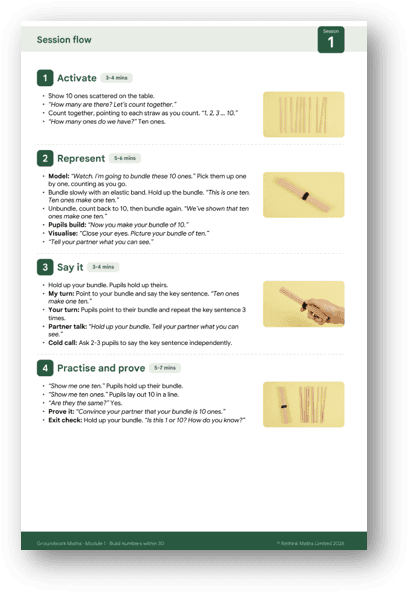
The adult teaches from a session card. The first page is a two-minute briefing, with everything the adult needs to prepare quickly. The second page is the session flow, a prompt to glance at while teaching, organised by the four parts of the session.
Each card gives the key mathematical sentence pupils will rehearse, the questions worth asking and what success looks like. As pupils work, the adult watches and listens, using the Watch For and Listen For prompts on the card, and responds to what each pupil needs in the moment.
Talk it through with us.
Send us a question, or tell us a little about your school, and we’ll get back to you. If you’d rather talk, you can book a call instead.
Or email hello@groundworkmaths.com